

A Creative Approach to Teaching Science Outdoors
[Ad-gifted] Compiled by Dr Penny Fletcher and Dr Sai Pathmanathan, two very experienced science education professionals, A Creative Approach to Teaching Science Outdoors is aimed at primary teachers but also intended to fulfil the needs of other groups such as home educators. It puts emphasis on the importance of getting children outdoors to explore and learn, and shows how the activities align with key stage 1 and 2 science objectives in a handy table at the front of the book.
This book is part of a ‘Creative Approach’ series published by Bloomsbury Education.

What’s inside A Creative Approach to Teaching Science Outdoors?
Fifty activities are provided in the book, covering a number of different science topics such as living organisms, rocks and earth, sound and light, and of course seasonal changes and the environment. The activities are designed around low or no-cost materials such as twigs, nettles, string, bicarbonate of soda, etc. and can be completed throughout the seasons, making this book adaptable to the needs and circumstances of the user and the time of year that they are giving the lesson.
This book is like me – only more organised
It is interesting to approach a book like this from my ‘alternative’ situation, having never stepped inside a school classroom in my youth, and now teaching my own child at home. I had few formal science lessons until I was 15 (I remember an ancient geology book and the periodic table) but spent a huge amount of my childhood outdoors, roaming the moors and ravines around our home, following and listening to my well-read sister who seemed to know every tree, leaf, animal and rock from the age of five as well as dinosaurs, the constellations and goodness’ knows what else.
Later on, the science teacher we girls hired (with the vague idea of taking science GCSEs) was quickly dispatched after he argued that 4 x 7 = 26 and that one could eat cyanide-laced oranges with no ill effects! The great outdoors was the ultimate classroom.
This book affirms how important it is to be out learning in nature rather than stuck in a classroom. It provides a structure that validates this argument for teachers who need more of a framework around this learning to provide evidence of what is being taught.
So here I am, home-educating a dinosaur-mad boy who has a similar approach to nature and science: use books indoors (and YouTube for the digital native) and get outdoors for lessons that the wind, rain, earth and rocks can teach us.

What we did
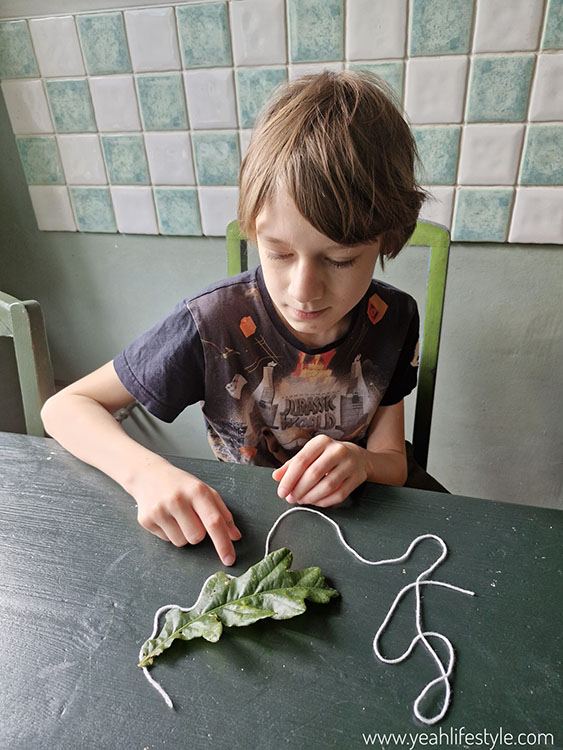
The activities have wonderful, humorous names, which I love, such as ‘The hole illusion’ – an activity that focuses on optical illusion and looking through your own hands! This taught us about light ad vision and how it can be distorted through different lenses. Also ‘Stringing along’ – measuring the perimeter of a leaf with string; this is a mathematical activity which helps a child to understand taking measurements for irregular objects. ‘Seeds of time’ was a further activity on germination and growth, where we tried growing some seeds in tissue paper. Unfortunately Daddy likes tidying up and the seeds, which had been germinating happily on the windowsill in their makeshift compost, disappeared before they got anywhere!

A thoughtfully and carefully designed layout
Each chapter is carefully and methodically laid out for the teacher/parent/adult to deliver the lesson, with a list of items that they need. There are some hands-on chemistry lessons, such as finding the acidity levels of different food items, and some activities that are suitable for the younger, more restless child that loves to run about exploring, such as how sounds are made.
I might personally have little use for a table that demonstrates how the activities fit in with the school curriculum, but for a teacher I imagine it would be incredibly helpful to document the learning journey. I do provide a yearly LA report on my child’s education and it is interesting to see how activities that we do answer different parts of the key stages and beyond.
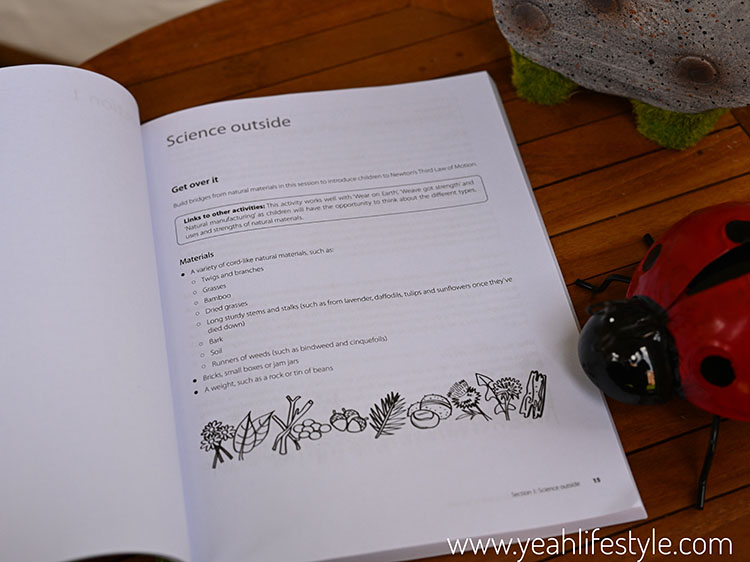
As it is a teaching aid, it is not full of pictures (although there are some), and at first I found it a little confusing how the activities are not divided into defined chapters but are presented in three sections. It is wordy, but it is packing a lot of information in. You might find it useful to add notes or markers as you go through the pages to help keep track of the topics.
How this book can help you and your child
This is a book that can be picked up and used at any time. It does not need to follow a curriculum, a school year, a schedule. You can build it into one if you like, but I would say that the best approach is to take from it what you feel you need, and what your child is interested in exploring. My little tip? Why not try some of the activities at home during the school holidays if you hear a whisper of ‘I’m bored’? I don’t doubt that the adults in the room… I mean, in the garden, of course… will be just as engaged with the science lessons as the kids will.
How much is A Creative Approach to Teaching Science Outdoors and where can you buy it from?
A Creative Approach to Teaching Science Outdoors is available in paperback format from good bookshops or Amazon for £15.24. Please check the website for the latest pricing as this might change.
About Bloomsbury
Bloomsbury Publishing is a leading independent publishing house, established in 1986, with authors who have won the Nobel, Pulitzer and Booker Prizes, and is the originating publisher and custodian of the Harry Potter series. Bloomsbury has offices in London, New York, New Delhi, Oxford and Sydney. Within Bloomsbury’s Academic division, it publishes under Bloomsbury, as well as under a number of prestigious and historic imprint names. Read our story for how it all began.

About the Book
Publisher : Bloomsbury Education
Print length : 160 pages
ISBN-13 : 978-1801994835
Item weight : 326 g
Dimensions : 18.9 x 1.3 x 24.5 cm

Review by : Metia Bethell
You may also want to read this:
Book Review: Birds, Beasts and Bedlam by Derek Gow
Book Review: The Little Book of Hygge by Meik Wiking
Book Review: Wind in the Willows by Kenneth Grahame
* Disclaimer: We were given a copy of the book in return for a feature. All opinions are our own.

22 comments
This book is such a great resource. Children learn by doing, and science is the perfect subject for that approach.
Absolutely, especially if you are home schooling them and need good experiment ideas
This book looks amazing for outdoor science learning! Perfect for both home and classroom settings.
Absolutely Marie, a fab book to add to your collecting if you enjoy hands on activities
It’s perfectly springtime and a great time to teach about the outdoors. This sounds like a fantastic tool for those wanting to get out more with little ones.
Absolutely and especially now that we are having the weather for it
I really liked this idea of teaching science outside, it makes it feel so much more hands on and fun for kids. My son loves being outdoors, so this gave me a few ideas to try with him.
Thanks Corinne, yes nothing like doing hands on experiment to help with learning science and everything about nature
As someone with a science background I do love to try to teach my children related things of interest where possible. This book sounds like it would be a perfect tool to help me do this in fun and creative ways.
I bet you would totally enjoy this book Melanie
This is sooo cool…I love that the book provides a practical and fun approach to learning science, really fun. I will get it for my nephew, he loves science.
How wonderful to hear that, I bet he would totally enjoy this book
Science has always felt like something that needs to be outdoors to really appreciate. And it’s great to have some guidance on how to do this x
I agree, science is so hands on and not just about reading it from a book
The activities you did are absolutely amazing! Such a great way to teach something so important. Keeping some tips for myself 😉
Thank you, I home school my kids so these are the things we tend to do together as part of our learning activity
These activities are something me and Nila would spend hours doing outside , we love this type of stuff !
How wonderful to hear that Kira, this book is so worth it
So wonderful to know that A Creative Approach to Teaching Science Outdoors is aimed at primary school teachers. Thanks a lot for recommending this book.
You are so welcome and this book is a great resource to keep kids busy during the holidays too
I have a friend who homeschools her kids and is always looking for creative ways to teach. I’ll have to tell her about this book!
I am sure this book will be perfect for her as it is filled with lots of resources in it